English
 français
 русский
 فارسی
فارسی español
 português
 العربية
 Indonesia
 Česky
Česky românesc
 български
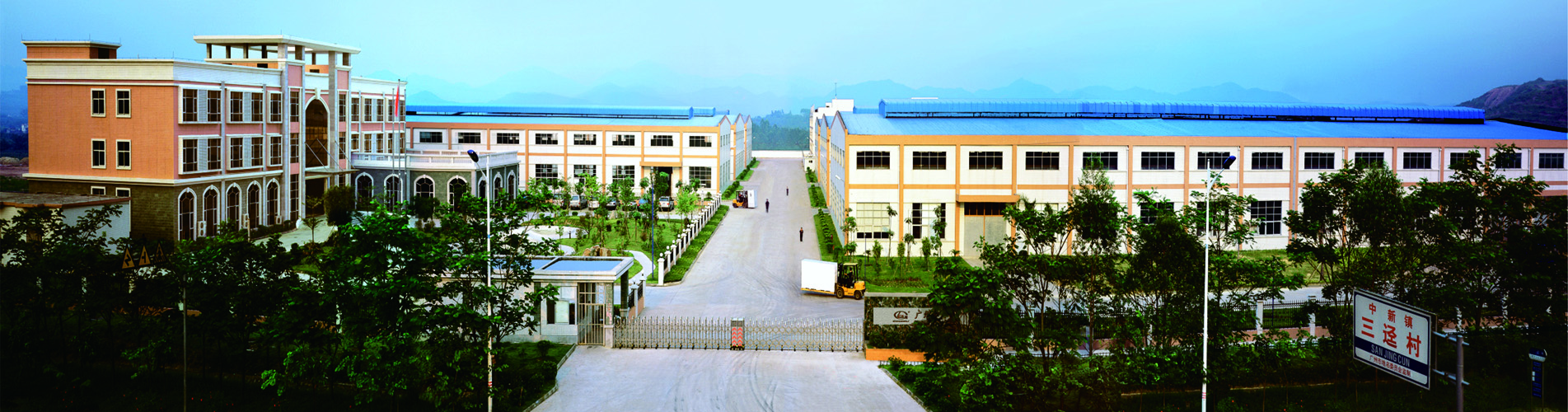
You step back from the classic car, its fresh coat of deep crimson gleaming under the lights. Then you spot it: a tiny dust speck, frozen in the clearcoat. Hours of careful work, ruined in an instant. This frustration drives professional shops to ask a critical question: why does downdraft technology outperform other airflow designs for flawless finishes?
This article defines the downdraft paint booth, explains its airflow mechanics, and explores its applications. You'll learn the technology's strengths, its trade-offs, and how to select a booth matching your production needs. By the end, you'll make an informed investment decision.
Key Takeaways
- A downdraft paint booth pushes clean air down from the ceiling and out through the floor. This vertical airflow removes overspray and dust from your work area.
- This design gives you a cleaner finish with fewer flaws. You spend less time sanding and buffing after each paint job.
- Downdraft booths also improve your safety. They pull harmful fumes and particles away from your breathing zone quickly.
- The main downside is higher cost. You need a raised floor or a pit for installation, and the system uses more energy than other booth types.
How Downdraft Airflow Works
Defining the Downdraft Paint Booth
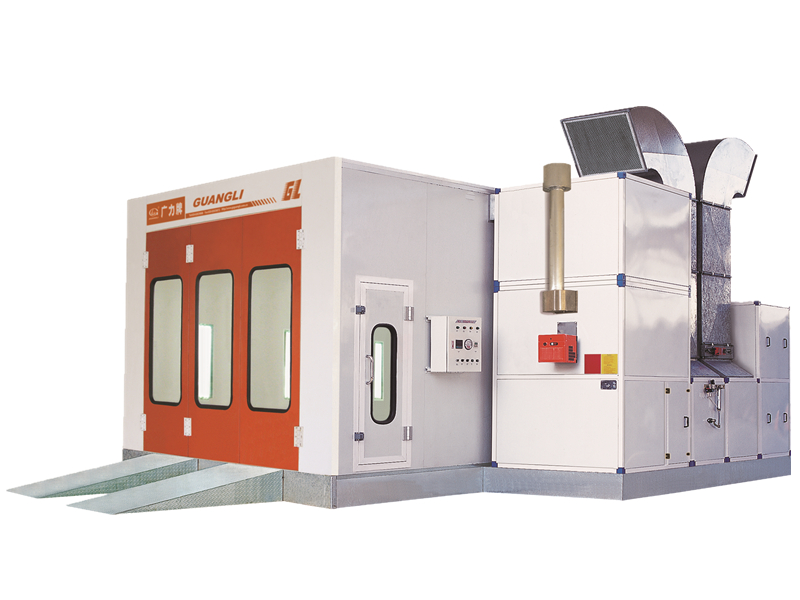
A downdraft paint booth is a fully enclosed spray booth designed for vehicles and large items. Its defining characteristic is the vertical air path: clean air enters through ceiling filters and exits through floor-level exhaust. This design creates a controlled environment where gravity works with the airflow rather than against it.
The system serves two primary functions. First, it establishes a clean working environment for refinishing tasks. Second, it efficiently removes overspray from your breathing zone and the work surface. You benefit from both improved finish quality and enhanced safety during operation.
The airflow begins in a full-length ceiling plenum. This plenum typically occupies most or all of the ceiling and contains an integrated filter that decontaminates air before it enters the booth. The air then flows vertically downward over the item you are painting. At floor level, an exhaust pit runs the length of the booth. This pit contains filters that catch overspray and remove toxic substances before the air releases through the booth's exhaust system.
Installation varies based on your facility layout. You can mount the booth on steel stands, which raises the floor and creates space for below-floor exhaust. Alternatively, you may need to construct a concrete pit beneath the booth. Each approach achieves the same result: a dedicated path for contaminated air to exit downward.
The Step-by-Step Airflow Process
Understanding the airflow sequence helps you appreciate why this design excels. Follow these three stages:
-
Stage 1 (Intake Plenum & Filtration): Air enters the booth's supply plenum and passes through ceiling filters that act as diffusion media. These filters combine a pre-filter with a final filter made of thermally bonded, progressively structured media treated with a tackifier. This combination captures particulates before they reach your workpiece.
-
Stage 2 (Vertical Flow & Floor Grates): Clean air continues downward and around the part, collecting overspray as it moves. The contaminated air pulls through exhaust filters located in a grated pit at floor level. These filters use continuous filament glass fiber with an open weave pattern for maximum efficiency.
-
Stage 3 (Exhaust Fans): Paint-laden air changes direction multiple times to prevent face-loading and fogging. It then passes through an exhaust fan sized to accommodate the static pressure of the filters. Manufacturers match motor and fan size precisely for each booth to operate below OSHA noise limits.
The performance difference becomes clear when you compare airflow designs:
|
Airflow Design |
Direction of Airflow |
Effect on Overspray Relative to Vertical Surfaces |
|---|---|---|
|
Downdraft |
Vertical, from ceiling to floor exhausts |
Air carries overspray straight down and away from the workpiece, preventing particles from traveling horizontally and settling on vertical surfaces. |
|
Crossdraft |
Horizontal, from one end of the booth to the other |
Air moves across the part, carrying overspray laterally, which increases the risk of particles depositing onto vertical surfaces. |
You can also distinguish downdraft from semi-downdraft systems:
|
Booth Type |
Airflow Direction |
Exhaust Location |
|---|---|---|
|
Downdraft |
Air enters from ceiling and flows vertically downward over the product |
Exhaust through floor pits or basement |
|
Semi-downdraft |
Air enters through a filtered ceiling section at the front, then flows diagonally towards the rear |
Exhaust at the rear of the workspace |
|
Crossdraft |
Air enters from one end and flows horizontally across the product to the opposite end |
Exhaust at the opposite end |
To quantify the system's power, consider a standard example. A booth measuring 16 feet wide and 14 feet tall operates at a typical air velocity of 50 feet per minute. The total airflow calculates as 16 × 40 × 50 = 32,000 CFM. Dividing this airflow by the booth volume of 8,960 cubic feet yields an air change rate of 3.5 air changes per minute. This rapid exchange keeps the atmosphere clean and safe throughout your painting process.
Common Applications for Paint Spray Booths
Automotive Refinishing and Collision Repair
Professional collision shops consistently choose the downdraft paint booth as their primary tool for achieving show-quality results. The vertical airflow pattern carries overspray directly away from vertical body panels, which matters most when you spray doors, fenders, and quarter panels. A crossdraft system pushes air horizontally across these surfaces, increasing the chance that particles settle onto fresh paint before it cures.
The finish quality difference translates directly into labor savings. Downdraft booths produce the fewest blemishes, which means you spend significantly less time cutting and buffing after each job. That reduced buffing time increases your throughput and lowers labor costs on every vehicle. Faster drying also contributes to shorter cycle times. You can control heat and airflow precisely, ensuring even curing for both waterborne and solvent paints. The result is a high-quality finish that meets customer expectations without costly rework.
Industrial and Custom Finishing Work
Beyond automotive repair, the downdraft design serves demanding industrial applications where surface perfection is critical. Industries that rely on this technology include:
- Aerospace component coating
- Marine vessel finishing
- Furniture manufacturing
- Heavy equipment and OEM production
Custom motorcycle painters and high-end furniture finishers also depend on the clean, controlled environment. The enclosed design provides a well-lit workspace that maximizes dust and fume capture, protecting both the operator and the workpiece.
For large machinery, you need a booth sized to accommodate the equipment. A typical booth for construction or mining vehicles ranges from 30 to 60 feet long, 15 to 20 feet wide, and 15 or more feet high. These large-format booths often use full downdraft or semi-downdraft spray booths airflow designs, depending on the facility's floor construction and exhaust requirements.
Typical booth for construction or mining vehicles: 30 to 60 feet long, 15–20 feet wide, and 15+ feet high.
The semi-downdraft spray booths alternative offers a compromise for facilities that cannot install floor pits. Air enters through a filtered ceiling section at the front and flows diagonally toward rear exhaust. This design still provides good overspray control for large parts, though it does not match the full downdraft's performance on complex geometries. When you finish aerospace components or marine equipment with intricate shapes, the full downdraft paint booth remains the superior choice for consistent coverage and contamination control.
Advantages and Limitations
Key Benefits for Finish Quality and Safety
The downdraft paint booth delivers its greatest advantage through vertical airflow. Gravity pulls overspray downward, away from the workpiece, rather than allowing it to drift horizontally across vertical surfaces. This directional control produces a uniform finish with fewer blemishes, which translates directly into less time spent sanding and buffing after each job. You achieve a high-quality finish on complex geometries that crossdraft systems simply cannot match.
Operator safety improves substantially with this design. The floor-level exhaust captures fumes and airborne particles before they reach your breathing zone. Efficient extraction keeps the atmosphere cleaner throughout the spraying process, reducing your exposure to hazardous paint vapors and isocyanates. The enclosed, well-lit workspace also minimizes dust intrusion, protecting both you and the workpiece from contamination.
Cost and Installation Considerations
The primary drawback of a downdraft system is the initial investment. You will pay more upfront compared to a crossdraft booth of similar dimensions. Installation often requires either steel stands that raise the booth or a concrete pit for below-floor exhaust. Facilities without existing pits face additional construction costs and potential structural reinforcement.
Operating expenses also run higher. The increased airflow volume demands more energy to heat and move air through the system. However, you can offset some of this cost through proper maintenance. A manometer tracks filter loading, and a high-quality filter typically lasts at least 100 operational hours before replacement. Clogged filters reduce airflow, strain exhaust fans, and create potentially flammable conditions. Regular inspection of machine manuals and manufacturing regulations keeps your spray booth code compliant and avoids fines.
Exhaust filters are mandated by the National Emission Standards for Hazardous Air Pollutants (NESHAP) to reduce health and environmental risks. When replacing filters, bag them with minimal shaking and dispose of them in an outside trash container. Never operate the booth without a filter during replacement. For facilities that cannot accommodate floor pits, a semi-downdraft spray booth offers a compromise, though it sacrifices some performance on intricate shapes. Weigh these factors against your production volume and finish requirements to determine whether the investment makes sense for your operation.
Selecting Your Downdraft Paint Booth
Key Specifications to Evaluate
Booth size determines every other specification. The primary determinant of your required CFM is the size of the parts you paint. For a downdraft booth, calculate CFM by multiplying the horizontal cross-section of the booth by the required face velocity, which OSHA mandates at a minimum of 100 feet per minute. Consider a standard downdraft booth measuring 16 feet wide, 40 feet long, and 14 feet tall operating at a typical air velocity of 50 feet per minute. The total airflow is 16 × 40 × 50 = 32,000 CFM, and the booth volume is 8,960 cubic feet, yielding an air change rate of 3.5 air changes per minute. Downdraft booths typically require 20 to 40 percent more air than crossdraft booths of the same dimensions.
Evaluate these factors when assessing your needs:
- Booth size and type. Larger booths for trucks or buses require higher airflow capacity, making downdraft systems ideal.
- Painting volume and frequency. High-production facilities benefit from downdraft systems to maintain consistent output and quality.
- Budget constraints. While downdraft costs more upfront, increased throughput can justify the investment.
- Industry requirements. Automotive, aerospace, and industrial sectors each have different regulatory and finish-quality standards that dictate CFM needs.
Downdraft booths require 20 to 40 percent more air than crossdraft, adding to operational costs. For luxury vehicles or high-volume painting, the increased CFM is justified by fewer blemishes and less buffing time. Match the airflow style to your product. If you paint large vehicles like buses, a downdraft is necessary. For smaller parts, a crossdraft may suffice. Downdraft booths are challenging when painting the underside of large items like boats, as the painter works against the downward airflow.
Filtration efficiency is another critical specification to ensure compliance with environmental standards.
Safety regulations dictate your paint spray booth design and operation. The following table summarizes key requirements:
|
Standard |
Requirement |
|---|---|
|
NFPA 33 |
Fire suppression and interlocks that shut off spraying if ventilation fails. |
|
OSHA 29 CFR 1910.107 |
Covers spray finishing; requires 100 FPM face velocity, explosion-proof electrical, filtered exhaust. |
|
OSHA 29 CFR 1910.1000 |
Sets permissible exposure limits for solvents and isocyanates in coatings. |
Additional OSHA requirements:
|
Regulation |
Requirement |
|---|---|
|
29 CFR 1910.107 |
Requires 100 FPM face velocity, explosion-proof electrical, and filtered exhaust. |
Lighting levels also matter. You need sufficient illumination to detect imperfections before the paint cures. Adequate lighting is essential for quality control.
Why GUANGLI Booths Meet Professional Standards
Professional paint booths are designed to meet rigorous safety and quality standards, including compliance with NFPA 33 for fire suppression and OSHA 29 CFR 1910.107 for ventilation and electrical safety. These standards ensure a safe working environment and consistent finish quality. When selecting a booth, consider customizable options for size, filtration, and lighting to match your specific application. Proper installation and maintenance are also critical for optimal performance and compliance.
A downdraft paint booth delivers vertical airflow, superior overspray control, and a clean, safe workspace. These features make it the professional standard for flawless finishes. Before purchasing, assess your application type, production volume, and facility constraints. Consider whether your floor can accommodate pit construction or steel stands. If not, semi-downdraft spray booths offer a practical alternative with slightly reduced performance.
A quality downdraft paint booth is not an expense—it's an investment in consistent finish quality and operational safety. Explore product offerings from reputable manufacturers for tailored solutions and expert guidance. Contact a manufacturer today for a personalized quote or download a comprehensive buyer's guide to compare specifications.
FAQ
How Often Should You Replace Filters in a Downdraft Paint Booth?
A high-quality filter typically lasts at least 100 operational hours. Use a manometer to track filter loading. Clogged filters reduce airflow and strain exhaust fans. Replace them promptly to maintain safety and finish quality.
Can You Convert a Crossdraft Booth to Downdraft Airflow?
Conversion requires significant structural changes. You need either steel stands to raise the booth or a concrete pit for floor-level exhaust. Most facilities find it more practical to install a new downdraft paint booth rather than retrofit an existing one.
What Distinguishes a Downdraft from a Semi-Downdraft Spray Booth?
A full downdraft paint booth directs air vertically from ceiling to floor exhausts. Semi-downdraft spray booths route air diagonally from a front ceiling section toward rear exhaust. Choose full downdraft for complex geometries. Choose semi-downdraft when floor pits are impossible.
Can You Paint Large Vehicles in a Downdraft Booth?
Yes. Downdraft booths suit buses and trucks well. The vertical airflow handles tall, flat surfaces effectively. For very large equipment, you may need a booth 30 to 60 feet long. Consider semi-downdraft spray booths if your facility cannot accommodate floor pits.
What Safety Standards Apply to Downdraft Paint Booths?
NFPA 33 requires fire suppression and ventilation interlocks. OSHA 29 CFR 1910.107 mandates 100 FPM face velocity and explosion-proof electrical components. Ensure the manufacturer complies with these regulations.



 IPv6 network supported