English
 français
 русский
 فارسی
فارسی español
 português
 العربية
 Indonesia
 Česky
Česky românesc
 български
You need a high-quality Auto Paint Booth to run a profitable auto body shop today. Modern paint systems require strict environmental controls. Airborne dust ruins fresh paint quickly. Dust particles force your technicians to spend valuable hours on wet sanding and buffing. Reworking a single panel repaint costs $550–$1,650, which cuts directly into your profit margin. An advanced enclosure delivers dust-free finishes every time. Integrated ventilation systems provide complete VOC fume containment to protect your workers. Precise climate-controlled curing speeds up drying times significantly. Investing in professional equipment eliminates costly defects, maximizes daily vehicle throughput, and drives maximum return on your investment.
Key Takeaways
- High-quality paint booths block airborne dust. Body shops get clean and smooth vehicle finishes every single time.
- Advanced ventilation systems remove toxic chemical fumes quickly. Clean air protects workers and meets strict safety laws.
- Built-in heating systems speed up paint drying times. Faster curing allows body shops to fix more cars daily.
- Dust-free environments stop costly paint mistakes. Shop owners save money by avoiding expensive wet sanding and redoes.
Superior Climate Control and Finish Quality
Unpredictable shop environments ruin paint jobs. Airborne dust particles settle quickly on wet clearcoats and cause severe finish defects. A fully enclosed environment isolates your vehicle refinishing work from dirt, shop dust, and outside contamination. Precise climate management stabilizes internal conditions so paint adheres properly and cures effectively. You achieve a smooth, even paint coat every single time without spending valuable labor hours fixing avoidable surface flaws.
Advanced Air Filtration Systems
Intake air filtration systems clean incoming air before it enters the spraying environment. Standard paint booth supply systems utilize MERV 8 to 13 intake filters, while high-efficiency setups deploy MERV 11 to 16 media. Critical finishing spaces utilize HEPA filters that capture 99.97% of fine particles down to 0.3 µm. This multi-stage filtration stops fine airborne dust from settling on wet surfaces.
Controlling temperature and humidity inside an Auto Paint Booth protects clearcoat durability and finish appearance. Managing these environmental factors prevents common application flaws:
- High relative humidity causes micro-condensation on wet surfaces, leading to fisheyes, poor paint bonding, blistering, and peeling.
- High humidity reduces paint adhesion strength by up to 25% compared with drier climates (Smith et al., 2020).
- Short periods of high relative humidity initiate chemical degradation chains that shorten overall finish lifespan (Johnson, 2021).
- Uncontrolled temperature fluctuations cause repeated expansion and contraction, creating micro-cracks, dulling, hazing, and loss of gloss.
Quality supply fans and direct-fired burners deliver stable airflow and precise temperature control. Downdraft airflow maintains a clean working area, supporting uniform paint distribution across all panels. Recirculating airflow during the curing cycle creates a faster temperature rise and maintains high hot-air velocity over parts. This controlled atmosphere fosters strong bonding between coatings, ensuring accurate color matching and long-lasting gloss.
Positive Pressure Enclosures
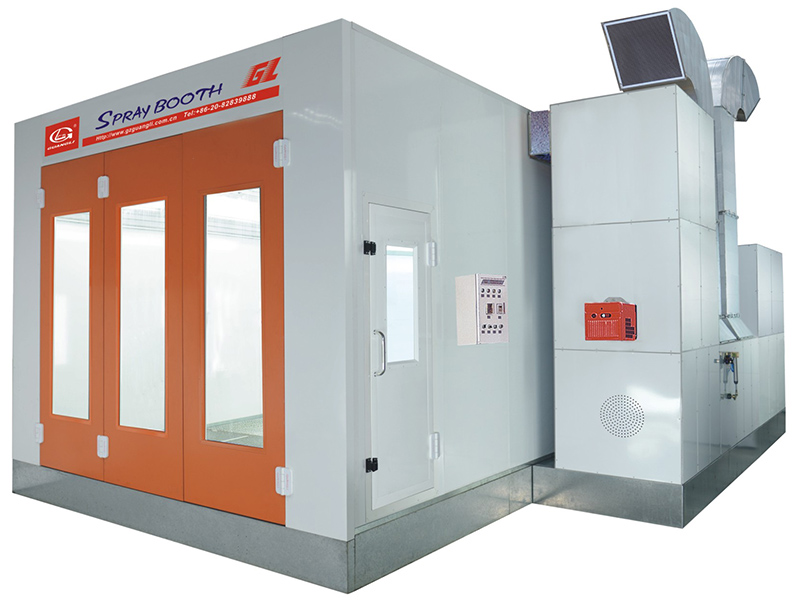
Maintaining positive pressure inside your spraying chamber eliminates airborne contamination risks. Negative pressure occurs when the exhaust system pulls out more air than the intake system supplies. That pressure imbalance draws unfiltered shop dust and debris through doors and structural gaps. Positive air pressure reverses this air movement completely. An air makeup unit supplies conditioned, filtered air at a volume slightly higher than the exhaust volume. This mechanical balance forces clean air outward through doors and openings, blocking dirty shop air from entering the work space.
Operating your enclosure at a targeted positive pressure of 0.04 to 0.05 inches water column prevents external dust from entering the chamber during vehicle entry and exit.
Positive pressure design also provides exceptional overspray control. Directed airflow moves paint overspray directly toward exhaust filters, preventing unintended paint drift onto adjacent vehicle surfaces. Technicians achieve crisp, sharp paint lines and smooth coats without overspray contamination. Automotive paint booths remove unpredictable open-shop variables, enabling your technicians to deliver consistent, showroom-ready results. This reliable environmental control minimizes defect rework like wet sanding, lowers material waste, and maximizes shop production output.
Health, Safety, and Regulatory Compliance
Toxic VOC Fume Extraction
Protecting your technicians from dangerous chemical vapors requires robust mechanical ventilation. Professional refinishing operations release hazardous volatile organic compounds and paint overspray directly into the shop workspace during daily coating procedures. Multi-stage extraction systems eliminate these dangerous elements rapidly. Glass fiber arrestors capture fine paint particles, while carbon-integrated exhaust filters adsorb active solvent vapors to eliminate toxic odors completely.
|
Filter Type |
Primary Function |
|---|---|
|
Glass fiber arrestors |
Captures fine particle overspray |
|
Carbon-integrated filters |
Adsorbs VOC vapors and eliminates odors |
Rapid air extraction prevents toxic chemical build-up inside your facility during heavy spraying sessions. Solvent exposure irritates worker lungs, causes persistent dizziness, and risks permanent organ damage over time. Isocyanate chemicals demand severe containment. NIOSH sets an exposure ceiling limit of 0.02 mg/m³ for all isocyanates, while OSHA enforces a 0.02 ppm ceiling for MDI. Recommended spray booth systems deliver 4 air exchanges per minute to maintain safe breathing conditions for shop operators.
OSHA and EPA Environmental Standards
Meeting strict federal regulations protects your auto repair business from costly fines and operational shut-downs. OSHA standard 1926.57 requires your spray booth system to supply clean make-up air in quantities equal to the total exhausted air volume. You must install a readable pressure gage across intake and exhaust filters to display exact maintenance intervals. Furthermore, NFPA 33 safety guidelines mandate keeping flammable vapor concentrations below 25% of the lower explosive limit inside active spray zones.
Environmental laws strictly govern commercial spray painting operations across all repair facilities. The EPA enforces 40 CFR Part 63 Subpart HHHHHH, commonly called the 6H rule, to reduce target hazardous air pollutants in automotive refinishing. Installing a modern Auto Paint Booth ensures full legal compliance through high-efficiency filtration media and controlled airflow dynamics. Superior environmental compliance protects technician health, prevents legal penalties, and enhances your shop's long-term commercial reputation.
Operational Efficiency and Faster Curing
Integrated Thermal Curing Systems
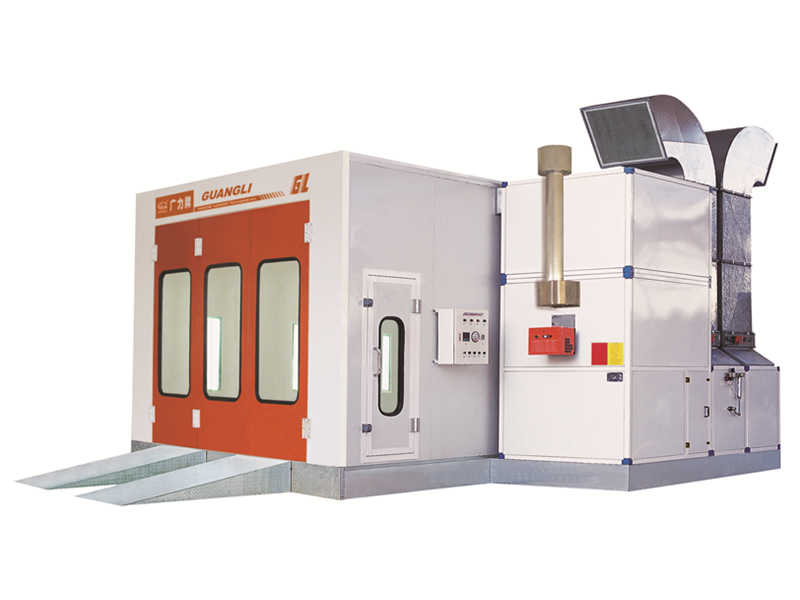
You accelerate vehicle production when you install high-performance paint spray booths equipped with advanced thermal systems. Raising internal temperature above the baseline accelerates chemical cross-linking in catalyst-cured coatings. Waterborne paint dries about 2× faster than ambient air drying when you set the booth temperature just 5°F above ambient air. Catalyst-cured automotive paint requires a minimum booth temperature of 55°F. Every 15°F temperature increase above 70°F doubles cure speed for catalytic coatings, whereas every 15°F drop below 70°F halves cure speed.
Modern heating units achieve specific substrate temperatures quickly to secure maximum paint hardness. Standard clearcoat bake schedules require a target object temperature of 140°F for 20 to 35 minutes. Infrared technology accelerates this drying process beyond traditional airflow methods.
IR ovens are typically 2–4 times faster than convection and can reduce total cure time by 60–90%.
Coating / product
Accelerated cure schedule
Temperature basis
PPG D8126 CeramiClear
30 min at 140°F/60°C
metal/object temperature
Axalta PE2400 2K Clearcoat
30–35 min at 140°F/60°C
object temperature
Sikkens Autoclear LV
20 min at 60°C object
object temperature (IR panel ≤100°C)
Streamlined Turnaround and Labor Savings
Controlled thermal regulation improves daily shop output while eliminating weather-related bottlenecks. Modern shops using REVO accelerated curing systems with one prep station and one auto paint booth can process up to 12 vehicles per day. That specialized configuration yields a throughput increase of up to 80 percent. You schedule refinishing jobs with complete confidence because indoor ambient conditions remain stable.
Efficient shop equipment reduces labor demands across every job stage. Eliminating environmental variables minimizes post-paint defect fixes like wet sanding and buffing. Eliminating post-paint defects directly protects your labor budget and keeps technicians productive. Optimized loading designs eliminate unnecessary vehicle movement inside your facility.
A high-production paint booth with a Side-Load Finishing System can save up to 15 minutes per cycle.
By eliminating extra driving steps between prep areas and automotive paint booths, your technicians devote maximum time to painting vehicles.
Long-Term ROI of an Auto Paint Booth
Auto Paint Booth Airflow Dynamics
Selecting the right ventilation layout directly controls your daily finish quality and shop productivity. Vertical downdraft airflow pulls contamination down and away from wet panel surfaces into floor exhaust pits. This downward motion forces metallic paint flakes flat and uniform, which eliminates striping on premium refinish jobs. Crossdraft designs move air horizontally across the workspace, which lowers equipment costs but increases particulate contamination risks.
Global Finishing states that in a downdraft paint booth, typical air velocity is 50 to 100 FPM. For example, using 50 FPM in a 16 ft x 40 ft downdraft booth gives 32,000 CFM and about 3.5 air changes per minute.
Proper air movement speeds up overspray removal and protects your technicians from lingering mist. Manufacturers like gzguangli engineer precise airflow chambers that stabilize internal booth pressure. This stable airflow eliminates turbulent air pockets and ensures consistent paint atomization across every vehicle panel.
Reduced Material Waste and Touch-Up Costs
Eliminating environmental contamination stops costly finish defects before they hit your shop bottom line. Fixing paint flaws drains valuable shop labor and wastes expensive coating materials. Defect correction on a two-stage paint job costs $500-$1,000, while three-stage correction runs $800-$1,500. Typical repair labor costs $75-$150 per hour over 8-20 hours. Professional touch-up services cost $500-$800, and minor chip repairs cost $150-$300 per panel.
A high-quality spray enclosure typically pays for itself within 12 to 24 months by eliminating these expensive redoes. An extra $2,000 per month in revenue from faster vehicle throughput speeds up your payback timeline significantly.
|
Scenario |
Payback / Break-even |
Supporting Financial Detail |
|---|---|---|
|
Growing auto body shop |
Payment covered immediately |
A $65,000 downdraft booth financed at $1,250 per month is more than covered by the additional revenue from just two extra vehicles per week. |
|
Custom car builder scaling up |
Within 18 months |
A $35,000 semi-downdraft booth has a $785 monthly payment, often less than two days of booth rental at $150–$300 per day. |
Investing in a modern Auto Paint Booth transforms your automotive repair shop operations completely. Premium enclosures deliver flawless, clean, dust-free finishes on every vehicle panel. Advanced ventilation systems guarantee total OSHA compliance while protecting your workers from toxic chemical vapors. Precise thermal controls accelerate curing schedules to increase daily shop production. Most importantly, eliminating post-paint defects lowers rework costs, expands your profit margins, and builds long-term customer trust.
Stop wasting valuable labor hours on unnecessary wet sanding and buffing. Upgrade your shop facility to modern, high-efficiency spray technology today, boost your daily vehicle throughput, and secure maximum return on your commercial equipment investment.
FAQ
How does an auto paint booth improve finish quality?
An auto paint booth eliminates dust, shop dirt, and airborne particles that ruin fresh coats. High-efficiency filters capture tiny contaminants before air enters the enclosure. Positive pressure pushes clean air outward continuously. You produce smooth, particle-free finishes while eliminating costly post-paint defects like wet sanding.
Which environmental standards regulate automotive paint booths?
Modern automotive paint booths meet strict EPA and OSHA safety requirements. OSHA standard 1926.57 mandates equal make-up air for exhausted air volume. The EPA enforces 40 CFR Part 63 Subpart HHHHHH to reduce target hazardous air pollutants. Compliance protects worker health while preventing heavy regulatory fines.
How fast do thermal curing systems dry automotive coatings?
Integrated thermal curing systems accelerate chemical cross-linking. Maintaining a target object temperature of 140°F dries standard clearcoats in just 20 to 35 minutes. Infrared technology cuts total cure times by 60 to 90 percent. You speed up job completion and increase your daily vehicle throughput.
Why should shop owners choose downdraft paint spray booths?
Downdraft paint spray booths pull airborne overspray straight down into floor exhaust pits. Typical air velocity of 50 to 100 FPM forces metallic flakes flat across every panel. This downward motion prevents finish striping, removes hazardous chemical mist rapidly, and minimizes expensive touch-up work.



 IPv6 network supported