When you pick an automotive spray booth, you control paint quality. You also help keep workers safe and manage costs. Clean spaces in new booths stop dust and dirt. This makes paint jobs look nicer. Most auto body shops use downdraft booths for trucks. The airflow and exhaust work well in these booths. Semi-downdraft booths save money and are easy to set up. Crossdraft booths cost less but need more work for great finishes. If you buy high-end booths, you can make more cars and get perfect results.

Key Takeaways
Crossdraft Automotive Spray Booths
Overview
A crossdraft automotive spray booth has a simple airflow. Air comes in from the front of the booth. It goes through intake filters that catch dust and dirt. The air moves straight across the car or parts you paint. Then, it leaves through the back exhaust chamber. This chamber also has filters to trap paint overspray. The air always moves in one direction. This helps keep the booth clean inside. The exhaust filter is made with special glass fiber. This stops clogging and fogging. Clean air keeps flowing out of the booth.
Main Advantages
Crossdraft spray booths have many good points for your shop:
Tip: If you want to save money and still get good quality, a crossdraft booth is a smart pick.

Key Drawbacks
You should think about some problems before you pick a crossdraft booth:
Downdraft Automotive Paint Booths
Overview
A downdraft automotive spray booth uses a special way to move air. Air comes in from the whole ceiling through filters.
The air enters from the top and moves straight down. It goes over the car or truck and into the floor pit. The floor has grates, and air passes through them. The air then goes into an exhaust pit under the booth. This helps catch extra paint and keeps dust away. Downdraft booths use more than one filter. First, a pre-filter grabs big pieces of dirt. Next, a HEPA filter catches tiny dust and paint. The booth makes the air pressure lower inside. This keeps the air clean and the paint smooth.
Main Advantages
Downdraft paint booths give your shop many good things:
Key Drawbacks
You should think about some problems before picking a downdraft booth:
Side-draft Spray Booths
Overview
You will find that a side-draft spray booth uses a unique airflow system. Air enters from the ceiling and moves sideways across the booth. The air then exits through exhaust filters on the walls. This design helps remove overspray and keeps energy use low. Unlike other types, such as crossdraft booths, side-draft booths give you more uniform airflow. You get better control over dust and paint particles. This means you can expect a cleaner space and a higher-quality finish.
Main Advantages
Side-draft spray booths offer several important benefits for your shop:
Note: A controlled painting environment helps you reach the best quality. You will see fewer defects and better results.
Key Drawbacks
You should know about some challenges with side-draft spray booths:
Semi-downdraft Automotive Spray Booths
Overview
You will find that a semi-downdraft automotive spray booth blends features from both crossdraft and downdraft types. Air enters from the ceiling and one end of the booth. It then moves downward and across the work area, finally exiting through the floor and the opposite end. This airflow design helps remove overspray and fumes from your workspace. You get a balance between the strong downward air of a downdraft booth and the simple setup of a crossdraft booth. Many shops choose this style for medium-sized operations because it offers flexibility and good quality.
Main Advantages
You can enjoy several benefits when you pick a semi-downdraft automotive paint booth:
Tip: If you want a booth that balances installation cost, safety, and finish quality, a semi-downdraft booth gives you strong value.
Key Drawbacks
You should know about some challenges with semi-downdraft spray booths:
The only downside of semi-downdraft paint booths is the potential for dead airflow spots at the front of the spray booth, along the floor. Dead spots, or areas where air does not flow properly over the product, can make spraying difficult even for the most skilled painter.
You may notice that these dead spots can affect the quality of your paint job. You might need to adjust your painting technique or booth setup to avoid uneven finishes. If you want the highest quality for every job, you should consider how airflow patterns in different spray booths can impact your results.
Comparing Automotive Spray Booth Types
Key Differences
When you look at spray booths, you see big differences. Each booth costs a different amount. Some are easy to set up, while others are harder. Air moves in different ways in each booth. The finish quality also changes with each type. Every booth works best for certain jobs in car and truck shops. You should check these things before you pick a booth for your shop.
Here is a table that shows the main features of each booth type:
|
Type of Booth |
Airflow Pattern |
Advantages |
Disadvantages |
|---|---|---|---|
|
Crossdraft |
Air drawn from front to rear |
Cost-effective, easy to install |
May not provide best air quality |
|
Semi-downdraft |
Mix of crossdraft and downdraft |
Improved airflow and paint quality |
More expensive than crossdraft booths |
|
Downdraft |
Air drawn from ceiling to floor |
Superior finish quality |
Higher cost, complex installation |
|
Side-downdraft |
Air pulled from sides to floor |
Balanced airflow and quality |
Requires more space and investment |
You can also see how finish quality compares across booth types:
|
Booth Type |
Advantages |
Limitations |
|---|---|---|
|
Crossdraft |
Economical, simple design, good for standard jobs |
Limited contamination control, lower finish quality |
|
Semi-downdraft |
Better overspray control, good balance of cost/quality |
Not as effective for high-end applications |
|
Side-downdraft |
Uniform airflow, higher quality finishes |
Higher cost, not for all applications |
|
Downdraft |
Best airflow control, ideal for premium finishes |
High initial and operational costs |
You should also think about how much each booth costs. The chart below shows how prices change with booth size and type:
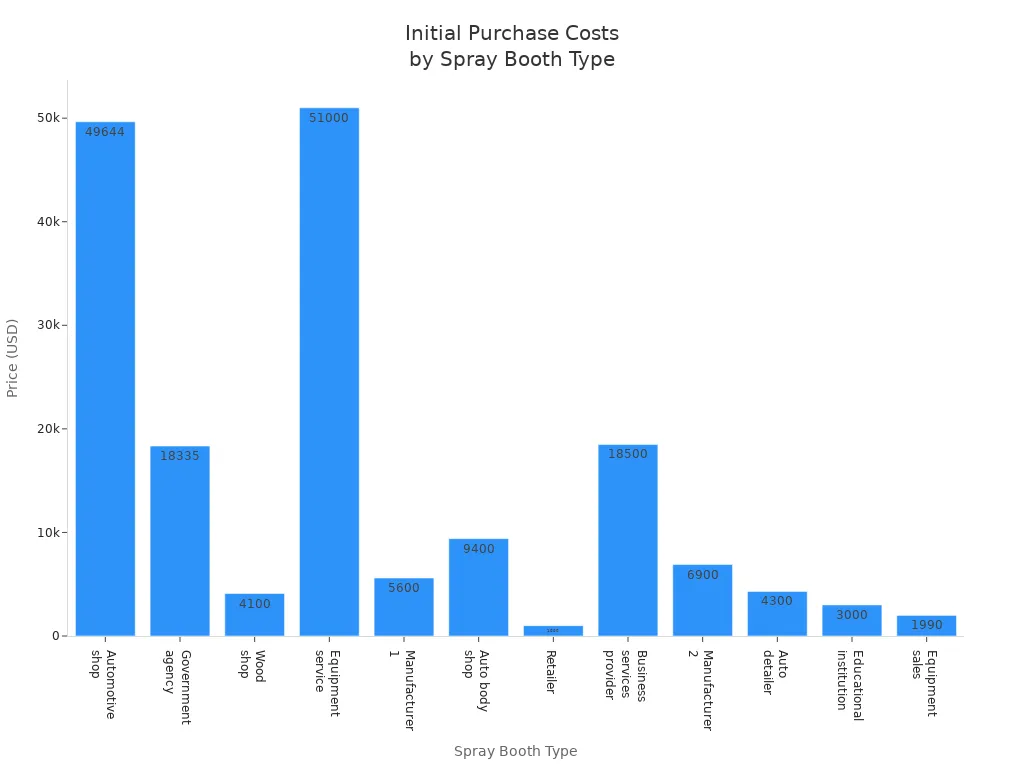
Downdraft booths use more energy because air moves from the top to the bottom. Side-downdraft booths use less energy and have good airflow. Crossdraft booths save money but may not save as much energy as downdraft booths.
You need to keep every booth clean. Clean your booth every day. Change filters often. Check the airflow to make sure it works right. Good filters and fans help stop dust and keep your shop safe.
NFPA and OSHA rules apply to all spray booths. Fully closed booths help you follow these rules and keep out dust. Always check your local rules before you buy a booth.
Choosing the Right Booth
Pick a booth that fits your shop’s needs. Here are some steps to help you choose:
Tip: If your shop is small, a crossdraft booth is cheap and easy to put in. If you want the best results and have more money, pick a downdraft or side-downdraft booth.
Remember to keep your booth clean. Change filters often to keep it safe and working well. Good filters and fans protect your workers and your paint jobs.
Some shops forget to think about airflow or dust problems. Always pick a booth that fits your space, money, and quality needs. This helps you do the best work for your customers and your shop.
You can look at the table to find the main good and bad points for each spray booth type:
|
Booth Type |
Pros |
Cons |
|---|---|---|
|
Crossdraft |
Low price, simple to set up |
More chance for dust |
|
Downdraft |
Best paint job, less dust |
Costs more, harder to install |
|
Side-draft |
Air moves evenly, filters work well |
Needs bigger space, costs more |
|
Semi-downdraft |
Good price and paint quality |
Air might not move everywhere |
Pick a booth that fits your shop’s size, money, and what you need to do. Good filters and airflow help stop mistakes and keep workers safe. Think about how your choice will help your shop work better for a long time.

China largest manufacturer of spray booths,furniture paint booths and man lifts since 1994


 English
 français
 русский
 فارسی
فارسی español
 português
 العربية
 Indonesia
 Česky
Česky românesc
 български
 IPv6 network supported